AAAI 2027 / Robot Learning
Anonymous Submission 01
GraspBridge
Zero-Shot Cross-Embodiment Bridging Between
Vision–Language–Action Policies and Specialist Grasp Planners
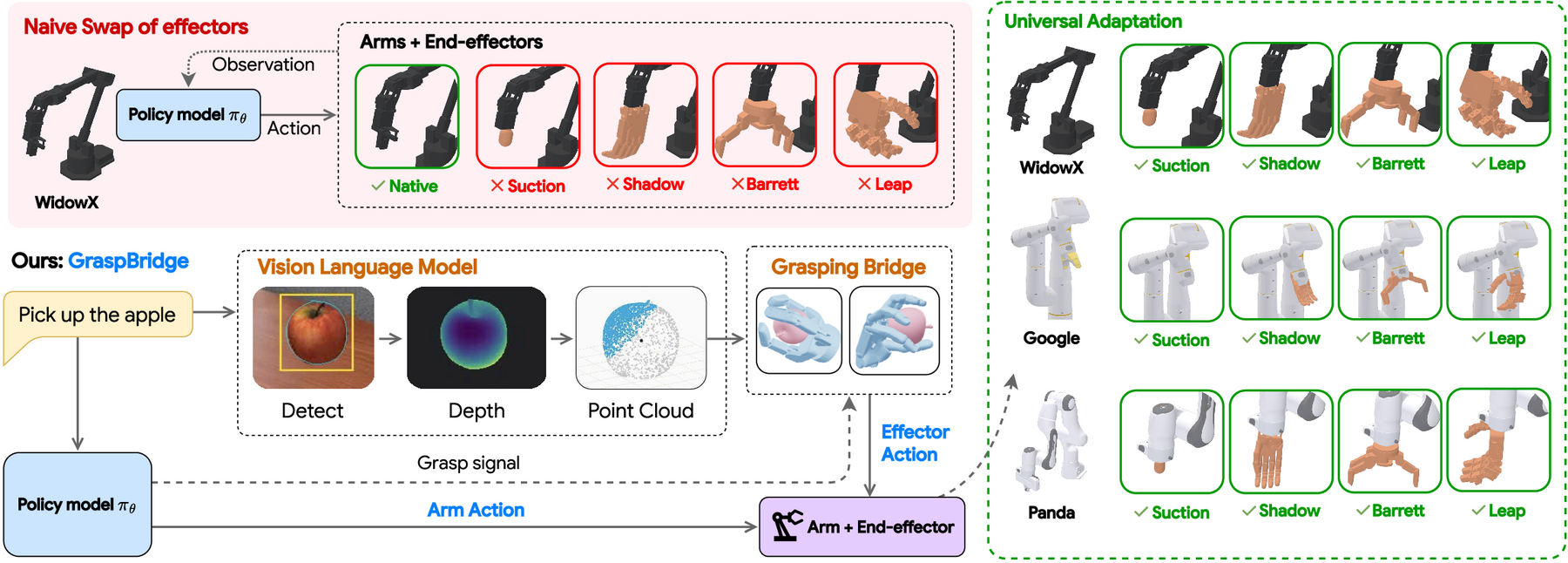
A frozen VLA keeps the task.
Only the failed grasp is delegated to a frozen specialist planner — then control comes straight back.
Policy
Plan
Execute
Transition
Policy
01 · MotivationThe generalist 02
The generalist
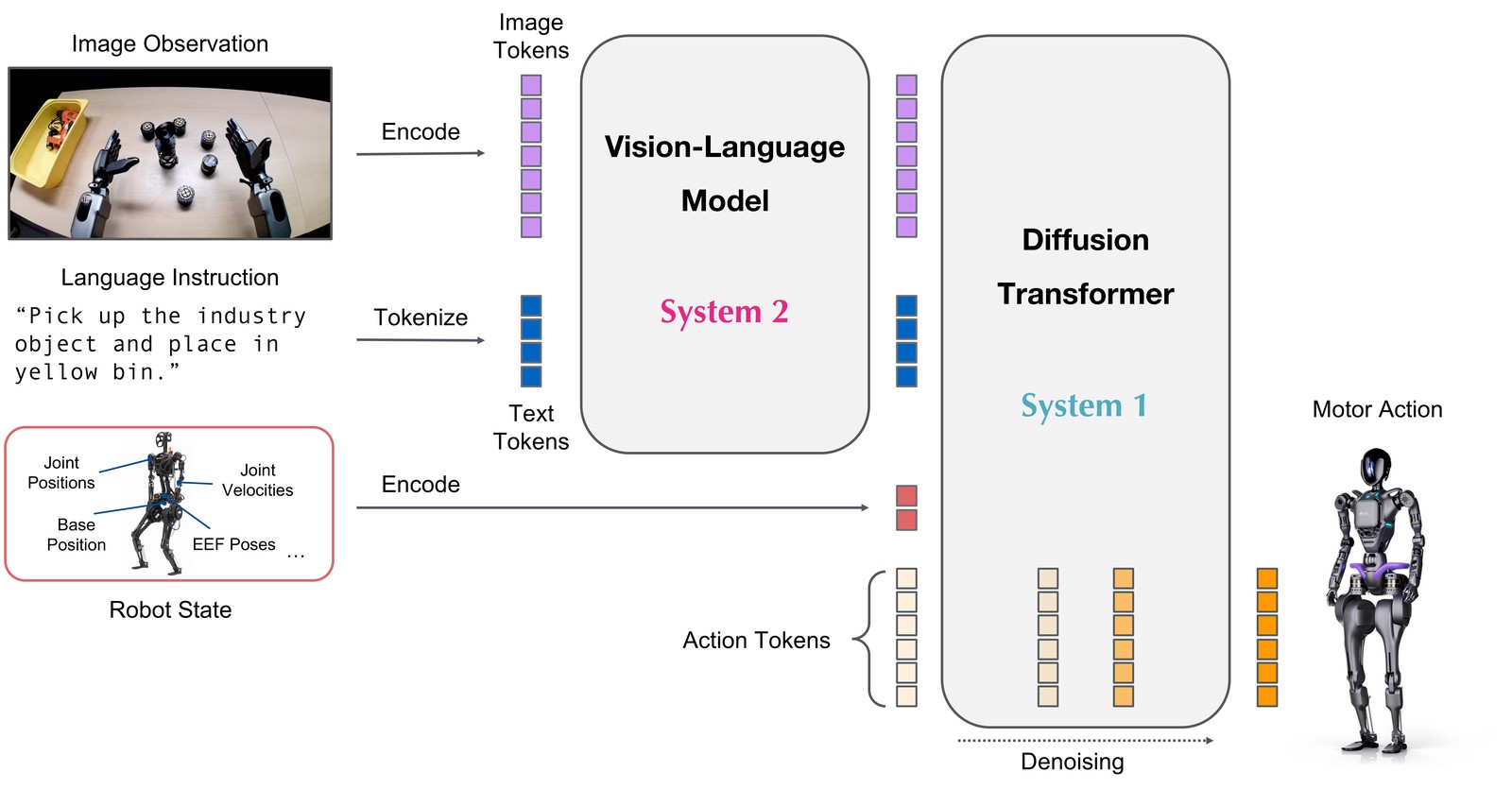
GR00T1 — a generalist model for
many robots.
πθ( a | o, ℓ )
A camera observation o and a language
instruction ℓ map to a short-horizon action chunk a. The parameters θ stay
frozen throughout this work.
InVision + language
OutActions, step by step
ScopeOne model, many robots
But it learned standard two-finger grippers —
not multi-finger hands, and not suction cups.
01 · MotivationWhere episodes break 03
The research gap
Reaching is reasoning.
Grasping is contact.
Reaching, transporting and placing are task-level
problems the policy handles well. Grasping is a contact-rich control problem with entirely different
physical constraints — and it is where generalist policies fail.
Grasp fails
WidowX · native two-finger jaw
the apple is too wide to hold
Nested phase indicators on failed rollouts with a swapped end-effector. The policy reliably arrives at the
object; the episode dies at contact.
01 · MotivationThe naive swap baseline 04
Cross-embodiment deployment
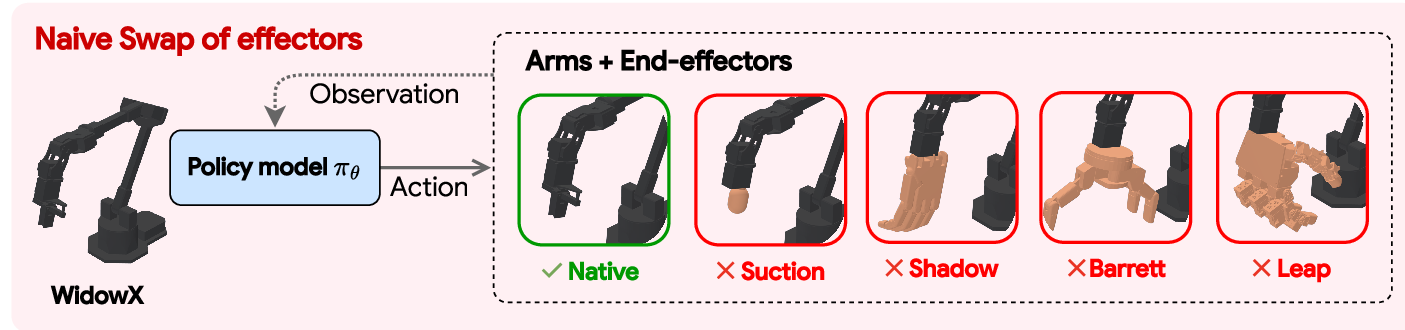
Change the hand and the grasp collapses.
The scalar gripper command is mapped straight to hand closure. Policy, tasks and seeds unchanged.
Naive swap · fails
WidowX · Barrett hand grafted in · the policy cannot drive it
≈100%
Still reach the object — the episode dies at contact
01 · MotivationGrasp synthesis 05
The grasp specialists
High-quality grasps for exactly these hands already exist.
Grasp planners take an object point
cloud and a hand model and return a ranked wrist pose, joint configuration and score. They are
task-agnostic — geometry only, no language — and they run as standalone systems, disconnected from any
policy.
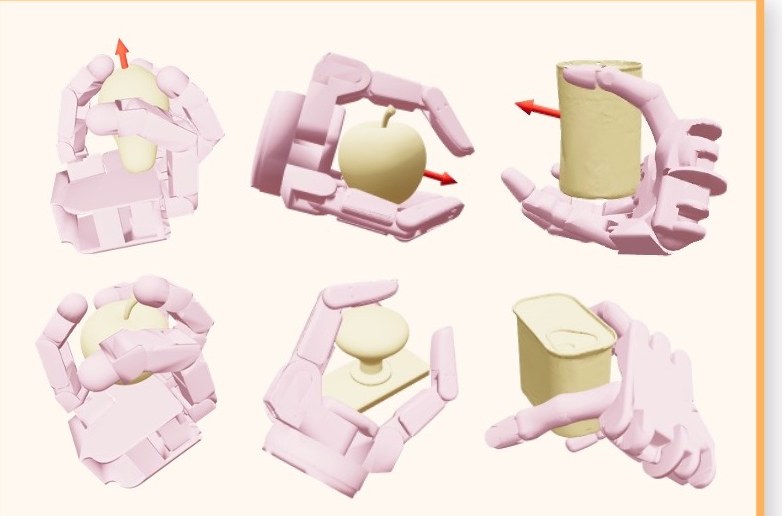
TRO-Grasp2 — learned graph diffusion
Ranked candidates for Barrett, Shadow and LEAP from a
partial cloud.
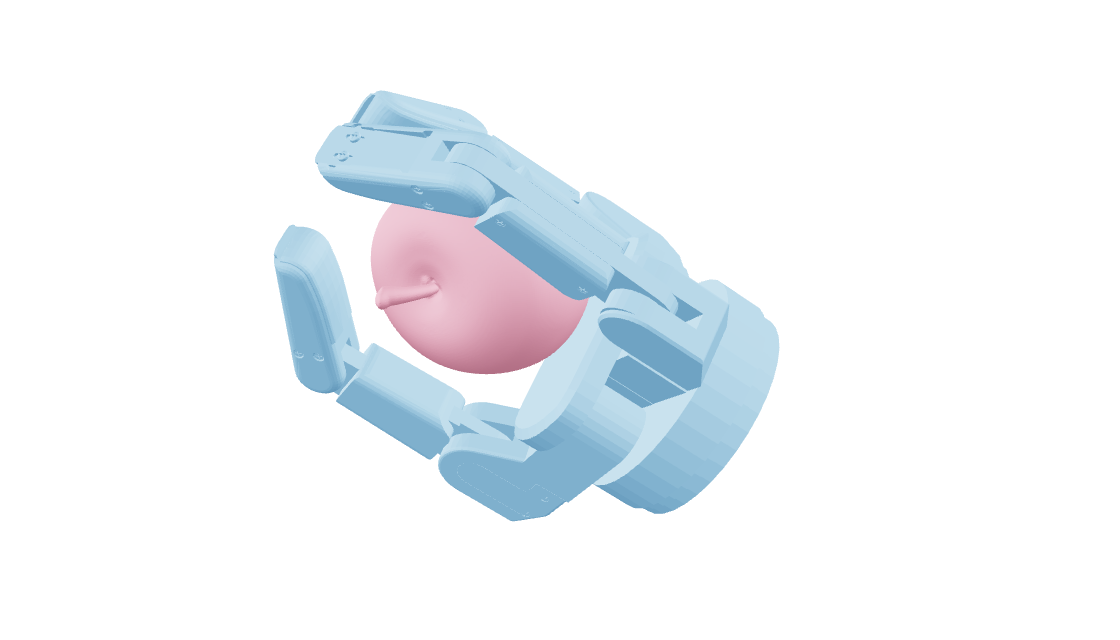
One planned grasp2 — Barrett on the apple
The planner's actual output: a wrist pose plus a joint
configuration.
SuctionNet4 — surface-normal contacts
Seal points and approach angles for the suction
gripper.
We evaluate three: TRO-Grasp2 (learned, dexterous, from a partial cloud),
BODex3 (pre-synthesised tabletop grasps for the same hands, aligned online to
the observed pose) and a suction planner4.
02 · MethodGraspBridge 06
The proposal
Compose at inference time. Retrain nothing.
MODULE A
Frozen VLA policy
Owns the language, the reach, the transport and the placement.
MODULE B
Frozen grasp specialist
Invoked only on a grasp signal. Sees geometry, never the
instruction.
THE INTERFACE
One service call
No shared weights. No co-training. Neither module is conditioned on the
other.
02 · MethodThe runtime handoff 07
Failure-triggered · phase-scoped
Four states, and control always comes back.
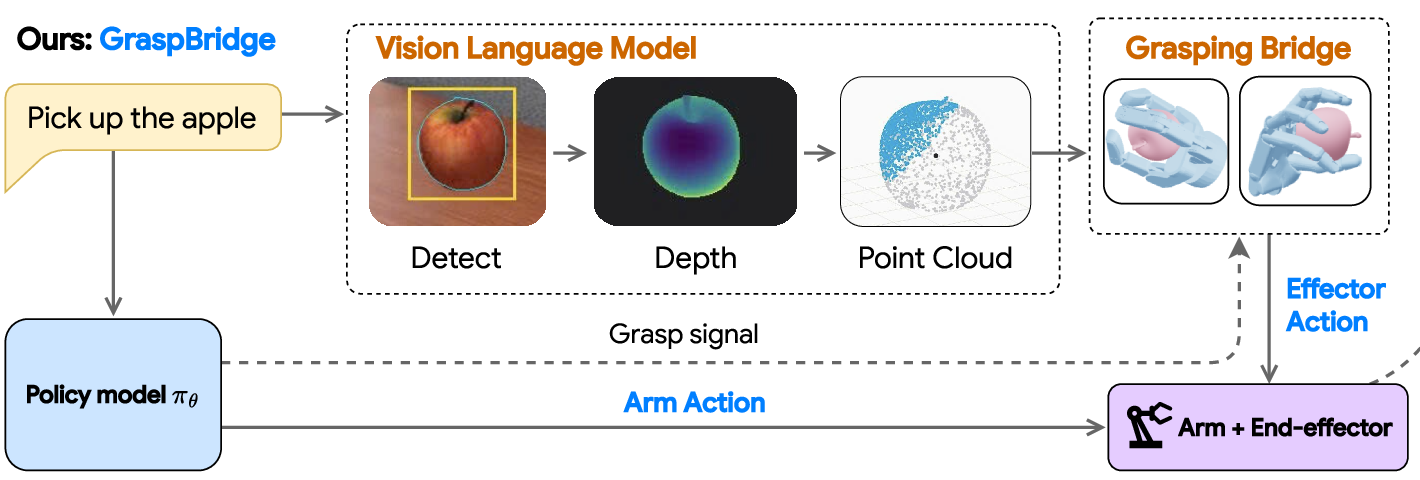
STATE 1 — POLICY
Forward, unmodified
VLA actions pass through untouched, while a detector watches for a failed grasp.
STATE 2 — PLAN
Build cloud, query planner
Reconstruct the object from the camera, and ask the specialist for a grasp.
STATE 3 — EXECUTE
Realise and verify
Drive the hand onto the grasp, close, and verify the lift — or retry.
STATE 4 — TRANSITION
Hand back in-distribution
Move to a canonical pose, so the policy resumes on familiar ground.
30–50
Ticks under specialist control
200–400
Ticks in the episode
1
Manipulation phase touched
Policy
Plan
Execute
Transition
Policy
02 · MethodThe loop in motion 08
The four states of the previous slide, running
Pass control, secure the object, hand it back.
Task success
State 1Reach
→
State 2Plan
→
State 3Execute
→
State 4Return
WidowX · Barrett · apple → plate
Task success
State 1Reach
→
State 2Plan
→
State 3Execute
→
State 4Return
Panda · suction cup · apple → basket
The same four states run in both clips: control passes to the specialist at State 2, the object is
secured and verified in State 3, and State 4 hands the arm back in-distribution. Contact
mechanics differ completely between these lanes — the wrapper and the interface do not.
03 · ExperimentsSetup 09
One wrapper, held fixed
Three arms. Four hands. Two simulators.
Frozen VLA policies
GR00T-N1.7-3BOcto-smallOpenVLA-7B
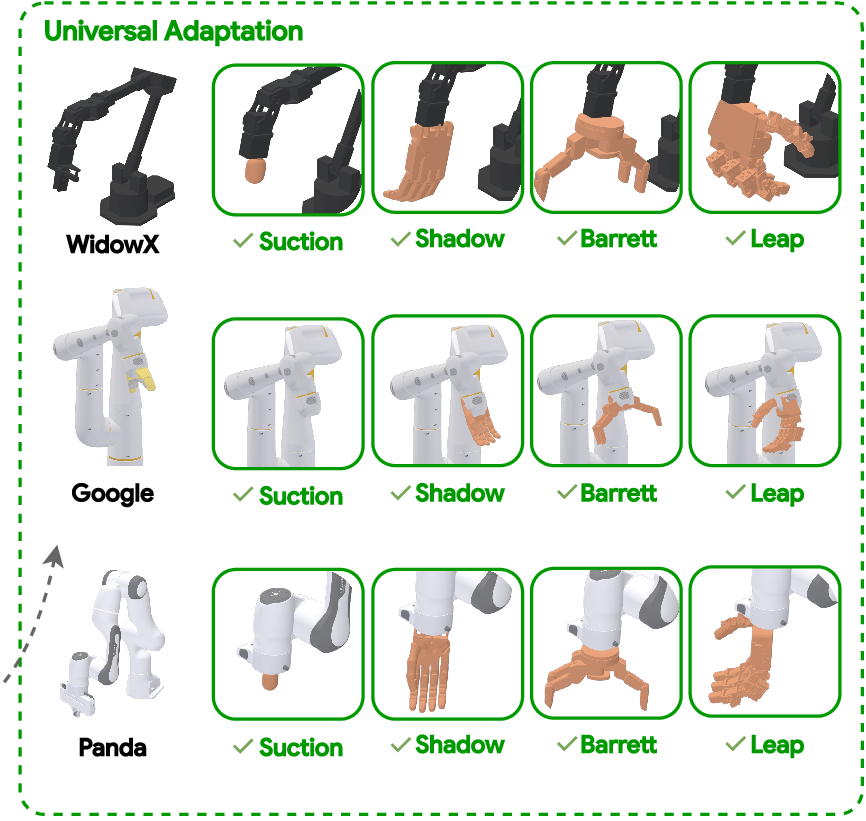
Arms
WidowX 250 S · 6 DoFGoogle Robot · 7 DoFFranka Panda · 7 DoF
End-effectors — none seen in any policy's training data
SuctionBarrett BH-282 · 3 fingerShadow · 24 DoFLEAP · 16 DoF
Grasp planners
TRO-GraspBODexSuction planner
Benchmarks · metrics
SimplerEnv · SAPIENLIBERO · MuJoCo6 tasks5 × 50 episodes
Baselines: the naive end-effector
swap (identical policy, tasks and seeds) and each policy's native parallel jaw as a reference.
We report task success and grasp success — the latter localises whether a failure belongs to
the specialist or to the downstream policy.
03 · ExperimentsMain result 10
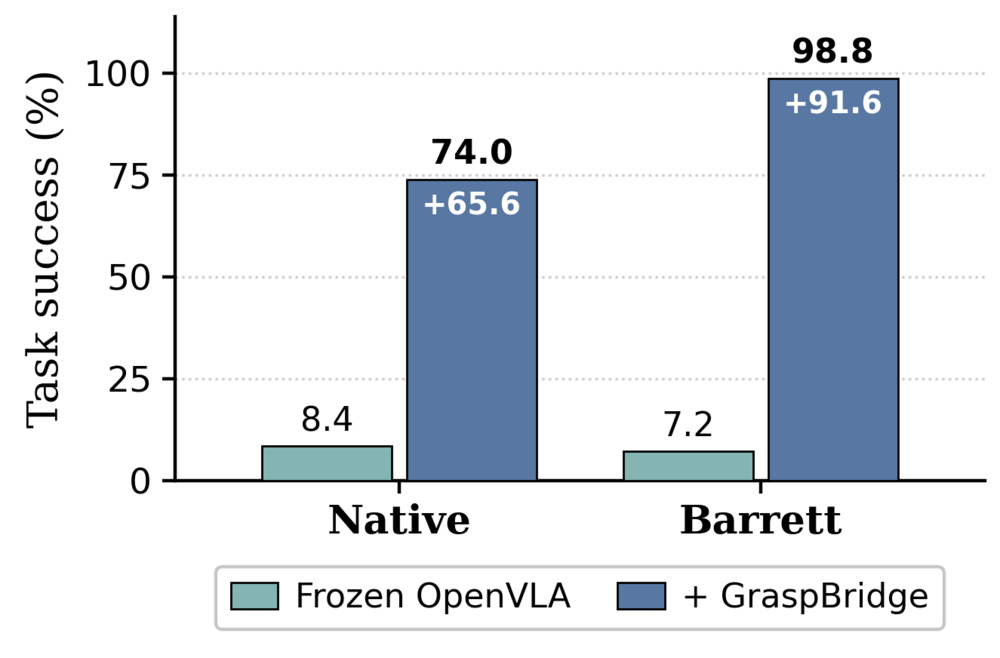
Task success (%) · naive swap vs +GraspBridge
GR00T-N1.7-3B results.
|
Native |
Suction |
Barrett |
Shadow |
LEAP |
| Arm | Task |
jaw |
naive | +Bridge |
naive | +Bridge |
naive | +Bridge |
naive | +Bridge |
| WidowX | apple → plate | 15.2 |
0.0 | 96.4 |
22.8 | 90.0 |
0.0 | 91.2 |
0.0 | 93.2 |
| WidowX | cube stack | 28.0 |
0.0 | 33.6 |
0.0 | 35.2 |
0.0 | 32.0 |
0.0 | 32.4 |
| Google | apple → can | 34.8 |
0.0 | 100.0 |
49.2 | 79.6 |
0.0 | 99.2 |
7.6 | 98.0 |
| Panda | red ball → basket | 8.8 |
0.0 | 100.0 |
0.0 | 66.8 |
0.0 | 64.4 |
0.0 | 90.0 |
| Panda | milk → basket | 90.4 |
0.0 | 99.6 |
62.8 | 88.4 |
0.0 | 89.6 |
0.0 | 90.8 |
Averaged over five runs of 50 episodes. cube stack is the exception, and not a grasp failure: it demands
a precise release above a second object, so it is placement-limited.
+89.8
Median gain, this table (pts)
0
Lines of policy code changed
04 · AnalysisPolicy-agnostic 11
Task success (%) · three frozen VLA policies
Results across policies.
| Policy | Shared lane | Native jaw |
Barrett
+Bridge | Shadow
+Bridge | LEAP
+Bridge | Suction
+Bridge |
|---|
| GR00T | WidowX · apple → plate | 15.2 |
90.0 | 91.2 | 93.2 | 96.4 |
| Octo | WidowX · apple → plate | 0.0 |
96.8 | 94.4 | 95.2 | 97.6 |
| OpenVLA | WidowX · apple → plate | 0.0 |
90.0 | 94.8 | 96.4 | 98.8 |
|
| GR00T | Google · apple → can | 34.8 |
79.6 | 99.2 | 98.0 | 100.0 |
| Octo | Google · apple → can | 22.4 |
76.4 | 96.8 | 95.2 | 98.4 |
| OpenVLA | Google · apple → can | 18.8 |
74.8 | 95.2 | 94.0 | 97.6 |
The three policies differ in
architecture, action parameterisation and training mixture. No policy-specific code is introduced.
OpenVLA-7B · WidowX · rubber duck → plate
ConclusionGraspBridge 12
Takeaways
VLA failures are not uniform
across an episode.
Task reasoning, navigation and
transport stay reliable under an end-effector swap. Only contact does not — so delegate only that
phase.
1
A training-free, phase-scoped handoff between two frozen modules
Neither retrained, fine-tuned, nor conditioned on the other. One unchanged interface across three VLA
families, three arms and four end-effector morphologies.
2
A grasp pose is not a grasp
The execution layer is the difference between a valid plan and a realised grasp — quantified mechanism by
mechanism, and embodiment-dependent.
3
Deployable from RGB-D alone, and dispatchable before it runs
Both the trigger and the planner input come from observations a real robot has; a pure-Python router
decides which arm–hand–task lane is admissible before any process starts.
WidowX · apple → plate0 → 96
Google · apple → can0 → 100
Panda · red ball0 → 100
Task success (%)
· naive swap → +GraspBridge
Best end-effector per lane · frozen GR00T
Policy
Plan
Execute
Transition
Policy
GraspBridgeOne interface 13
The whole system
One wrapper. Three arms, four end-effectors.
DemoLive demo 14
Live in the browser · nothing to install
An interactive results explorer.
Pick a policy, an arm, a hand
and a task — the selected run is then shown three ways.
VIEW 1 · RESULTS
The whole grid
The headline table as charts, and as the full grid behind them.
VIEW 2 · COMPARISON
Three lanes at once
Native gripper, bare swap and grasp specialist on one task, side by side.
VIEW 3 · VIDEO
One episode, phase by phase
A rollout under a timeline coloured by who holds control at each tick.
That timeline is the rail of this talk — base policy driving, planned grasp,
handoff / resume — so the claim of the paper can be checked run by run, rather than taken on the
tables alone.
crest-demo-handoff.pages.dev/demo/
Same runs, same
checkpoints and same seeds as the tables in this talk.
Policy
Plan
Execute
Transition
Policy